-p-500.png)
Aurora Delays Fully Driverless Semi-Truck Launch in Texas
Aurora Innovation postponed its planned launch of fully driverless commercial trucks in Texas from late 2024 until April 2025. The company said the additional time would allow it to continue validating its autonomous-driving technology before removing human operators from the vehicles.
Texas had served as a testing ground for autonomous commercial trucks for several years. Self-driving 18-wheelers had operated along Interstate 45, Interstate 30 and Interstate 20, but those vehicles typically included a safety driver who could intervene if something went wrong.
Aurora’s proposed launch represented a significant transition from supervised testing to commercial freight operations without a person in the truck. In addition to delaying the launch, Aurora scaled back its initial deployment plan to as many as 10 driverless trucks—approximately half the number previously planned.
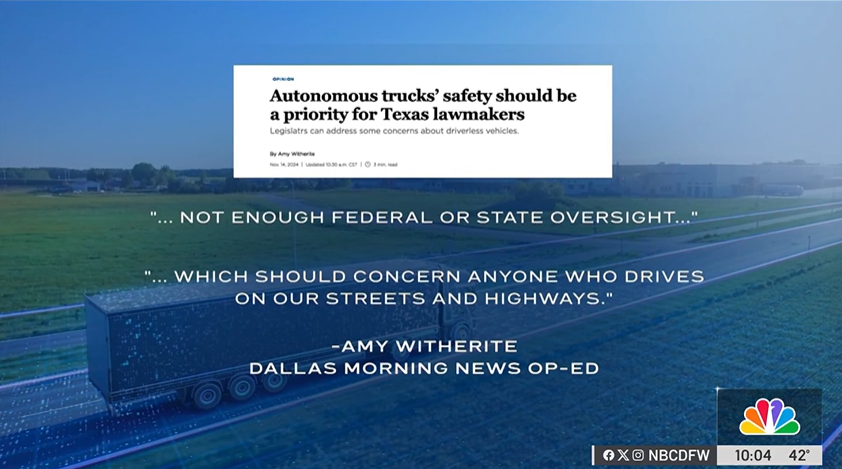
Amy Witherite, founder of Witherite Law Group and a traffic-safety advocate, welcomed the decision to allow more time for testing. Witherite acknowledged that crashes involving human-operated 18-wheelers continue to cause serious injuries, but questioned whether enough evidence existed to establish that autonomous technology was safer than a trained human driver.
“We as human beings certainly aren’t perfect. We certainly have many, many wrecks with 18-wheelers operated by human beings, but yet we’re not quite to the point where we show that the human being is less safe than a technology,” Witherite said.
Witherite also recognized the potential benefits of self-driving semi-trucks while emphasizing that companies should move forward cautiously.
“We just need to do this in a prudent and reasonable manner so that families aren’t tragically impacted by the rush to get driverless 80,000-pound vehicles on the roadway,” Witherite said.
The NBC 5 report also addressed government oversight of autonomous commercial vehicles. Witherite had previously raised concerns about whether existing federal and state safeguards were sufficient as companies prepared to remove human operators from large commercial trucks.
Aurora told NBC 5 that the company had worked with the Texas Department of Transportation, the Texas Department of Public Safety and local police departments while preparing for driverless operations.
The postponement highlighted a broader challenge facing the autonomous-trucking industry: balancing the potential benefits of emerging technology with the need to demonstrate that an 80,000-pound commercial vehicle can operate safely and reliably under real-world conditions.
Watch the NBC 5 report: Driverless Semi Company Pumps the Brakes in Texas